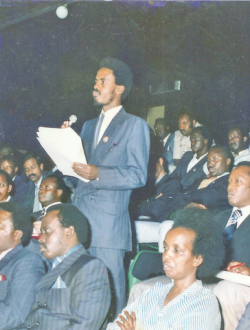

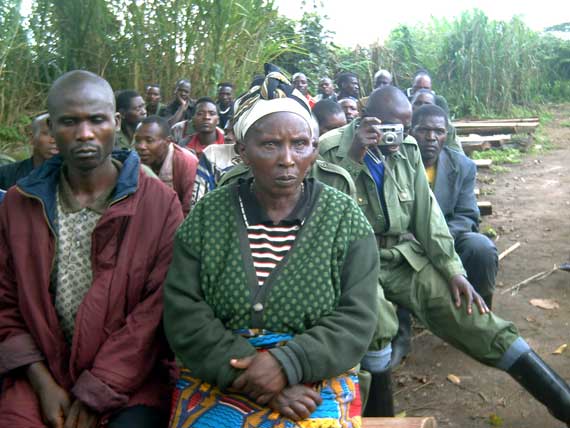
Dr Felicien Kanyamibwa, Secretary General of RUD-Urunana talks to Michael Kavanagh of National Public Radio (NPR) on why RUD-Urunana and General Kagame should negotiate.
Sunday, February 1, 2009.
To listen to the interview here is the link:
http://www.theworld.org/?q=node/24056
Dr Felicien Kanyamibwa also gave interviews on BBC World Service, WGBH/Boston and Public Radio International.
PRI Introduction: Rwandan Hutu militias have continued to survive in eastern Congo for a decade. In some cases, they’ve received support from Rwandans around the world, including some in the United States. Reporter Michael Kavanagh has the story of a Hutu rebel political leader who makes his home in New Jersey.
Read the Transcript
This text below is a phonetic transcript of a radio story broadcast by PRI’s THE WORLD. It has been created on deadline by a contractor for PRI. The transcript is included here to facilitate internet searches for audio content. Please report any transcribing errors to theworld@pri.org. This transcript may not be in its final form, and it may be updated. Please be aware that the authoritative record of material distributed by PRI’s THE WORLD is the program audio.
MARCO WERMAN: Hutu militias from Rwanda have managed to survive in Congo for more than a decade. That’s partly because they receive support from Rwandans around the world, including some in the US. Michael Kavanagh has the story of one of them now, living in New Jersey.
MICHAEL KAVANAGH: Felician Kanyamibwa took an odd road to rebel leader. He grew up in a wealthy family in Rwanda. He imported cars and owned a game park there. He moved to the US in 1990 when a civil war broke out in his country.
FELICIAN KANYAMIBWA: There people who watch TV and movies wish they could go to the United States. I read a lot about the United States. I idolized the United States, and I thought, you know, the United States was a place that you’d like to go if you have to live in an other country. But I did not come for economic reasons. I always thought I was going to go back.
KAVANAGH: But he never has. Kanyamibwa got a Doctorate in Business Administration at Penn State. His wife and three children eventually joined him in the US, and now they’re all US citizens. Meanwhile, the civil war in Rwanda turned into a genocide. Kanyamibwa has both Hutu and Tutsi relatives, but the ethnic laws of Rwanda at the time classified him as a Hutu. Yet, Kanyamibwa says his sister was killed in 1994 genocide because people thought she was a Tutsi. And in 1997, he says, dozens of his family members were killed when the new Tutsi-dominated government of Rwanda chased the genocide’s perpetrators into neighboring Congo. That’s when Kanyamibwa entered rebel politics. For over a decade now, he’s worked with other Rwandans outside the country to oppose the current government. He now runs an opposition group called The Rally for Unity and Democracy, or RUDE.
KANYAMIBWA: We think that there is a small clique of individuals who are ruling Rwanda. The majority happens to be Tutsis, but Tutsis and Hutus are also suffering. So we want to get all the groups together and stop that heritage of Tutsi or Hutu-led power.
KAVANAGH: And, RUDE leaders say, they will do it by force if necessary. RUDE has several hundred soldiers in eastern Congo. It’s a small force compared to other Rwandan Hutu militias there, but their aims are similar: return to Rwanda, justice for war crimes on all sides, and direct negotiations with Tutsi President Paul Kagame.
KANYAMIBWA: Kagame has said: “no way” All the dictators in the world have started that way. They said: “no way”, and it happens.
KAVANAGH: It happens?
KANYAMIBWA: Yeah. And it happens. By the end of the day, he will understand, because if he does not understand, then the end is going to be very, very bad.
KAVANAGH: This kind of rhetoric infuriates Rwanda, and it has now joined forces with the Congolese government to root out Hutu rebel groups in eastern Congo.
JOSEPH NSENGEMANA: For us, there is no need to negotiate with a force which is a genocidal force.
KAVANAGH: Joseph Nsengemana is Rwanda’s Ambassador to the UN. He says Rwanda considers Kanyamibwa and another US-based Hutu rebel leader, named Jean-Marie Higero, to be dangerous criminals.
NSENGEMANA: We give a list to the government of US, and Higero and Kanyamibwa are on the list. So we still hope that they will be arrested and charged.
WERMAN: And the US government has taken notice. Some rebels in eastern Congo participated in the genocide, and were members of groups that are on the State Department’s list of Terrorist Organizations. US officials declined to comment on potential or ongoing investigations, and neither would Kanyamibwa.
KAVANAGH: Have you been in touch with the US government?
KANYAMIBWA: Those are things that, …, I don’t know. I should not say that.
KAVANAGH: So yes?
KANYAMIBWA: I should not answer that. I hide nothing. Everything I do, it’s open.
WERMAN: Kanyamibwa also denies financing the rebels — something that could get him in trouble with the US Treasury Department. Jason Stearns is the head of a UN panel of experts who recently looked into rebel financing in eastern Congo.
JASON STEARNS: What we do know from talking, interviewing high-ranking RUDE officers who have deserted the movement as well as foreign intelligence officials is that RUDE, as opposed to other armed groups, does receive some financing from the Diaspora. And there have been allegations that some of this financing has come through Kanyamibwa and Higero, but we haven’t been able to substantiate these allegations.
KANYAMIBWA: I believe what I do is within the limit of the legal in the US. And if one day the US says, “You know what? What you’re doing is not legal,” I’m going to stop doing that.
KAVANAGH: Kanyamibwa feels his cause is justified.
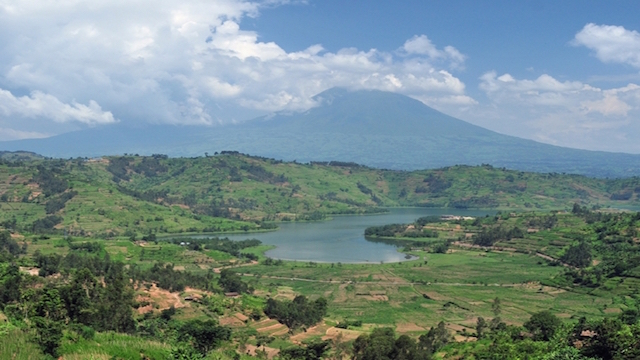
KANYAMIBWA: As a human being, I want democracy in Rwanda. You know, it’s an inspiration. I have my kids. They want to, they should be able to go back to Rwanda and say: “You know what? We have our ancestors there.” Rwanda is a beautiful place. I mean, it’s a place you want to go and enjoy time and come back. I want to be able to go there.
KAVANAGH: Even if he has to fight to make it happen. For The World, I’m Michael Kavanagh, Fair Lawn, New Jersey.
Copyright ©2008 PRI’s THE WORLD. All rights reserved. No quotes from the materials contained herein may be used in any media without attribution to PRI’s THE WORLD. This transcript may not be reproduced, in whole or in part, without prior written permission. For further information, please email The World’s Permissions Coordinator at theworld@pri.org.